How Digital Visual Acuity Testing Is Transforming Eye Care
Software-based eye charts are quietly changing how practices measure vision — improving accuracy, expanding what a single lane can test, and standardizing results across an entire clinic.
Published June 19, 2026 · By Mark S. Brown, MD
For more than a century, the eye chart barely changed. A printed Snellen chart on the wall or a projector at the end of the lane was simply how visual acuity got measured. Over the last decade, that has shifted: calibrated software running on a standard monitor now does the job that printed charts and projectors once did — and does considerably more. Understanding what changed, and why it matters clinically, helps practices decide whether it is time to move on from the projector.
From fixed charts to calibrated software
The core limitation of a printed or projected chart is that it is fixed. The letters never move, the sizes are set, and the only acuity notation available is whatever was printed. A digital system removes those constraints. The optotypes are drawn by software and sized in real time to the patient-to-screen distance, so the 20/20 line subtends exactly five arc-minutes at your lane distance rather than an assumed one. The same screen can present Snellen, ETDRS/LogMAR, color vision, contrast sensitivity, Worth 4-Dot, and pediatric optotypes on demand.
Why calibration and standards matter
Accurate acuity measurement depends on more than letter size. Background luminance, optotype contrast, and spacing all affect the result. Standards such as ANSI Z80.21 (luminance of 80–320 cd/m²) and ISO 8596 (optotype geometry) exist precisely because these variables matter. A projector bulb dims as it ages, quietly lowering contrast and shifting measurements over months. Calibrated software holds those parameters constant, which is one reason digital systems tend to produce more reproducible results over time.
One lane, every test
Perhaps the most practical change is breadth. A projector gives you Snellen acuity. A digital system gives you the full testing suite from the same screen:
- ETDRS/LogMAR for retinal disease monitoring and research
- Color vision and contrast sensitivity without add-on hardware
- Pediatric optotypes — Lea Symbols, HOTV, Tumbling E, Landolt C
- Randomized letter presentation so patients cannot memorize the chart between visits
For practices that monitor age-related macular degeneration or diabetic retinopathy, the ability to switch to ETDRS instantly — rather than maintaining a separate chart — is a meaningful workflow improvement. For a detailed look at when each chart applies, see Snellen vs. ETDRS.
Efficiency and standardization
Digital systems also remove friction. There are no bulbs to replace and no warm-up delay between patients. In a multi-location group, browser-based software means every lane runs the same version with the same calibration, so a measurement taken in one office is directly comparable to one taken in another. That consistency is difficult to achieve with a mix of projectors and printed charts.
The shift in one sentence: digital visual acuity testing turns a single monitor into a calibrated, standards-compliant testing station that does what a projector plus several separate instruments used to do.
Where it is heading
The next phase is cloud delivery: browser-based testing that runs on Mac or Windows with centralized administration across locations. That removes the last hardware constraint — the dedicated Windows PC — and lets a practice manage every exam lane from one place. The eye chart, after a century of standing still, has finally become software.
Frequently asked questions
Is digital visual acuity testing as accurate as a printed chart?
When properly calibrated to the patient distance and set to standard luminance, digital testing meets the same ANSI Z80.21 and ISO 8596 standards as printed charts — and avoids the contrast drift that affects aging projector bulbs.
Does digital acuity testing require special hardware?
Not necessarily. Browser-based systems such as AcuityMaster run on a standard Mac or Windows computer and the monitor already in your exam lane.
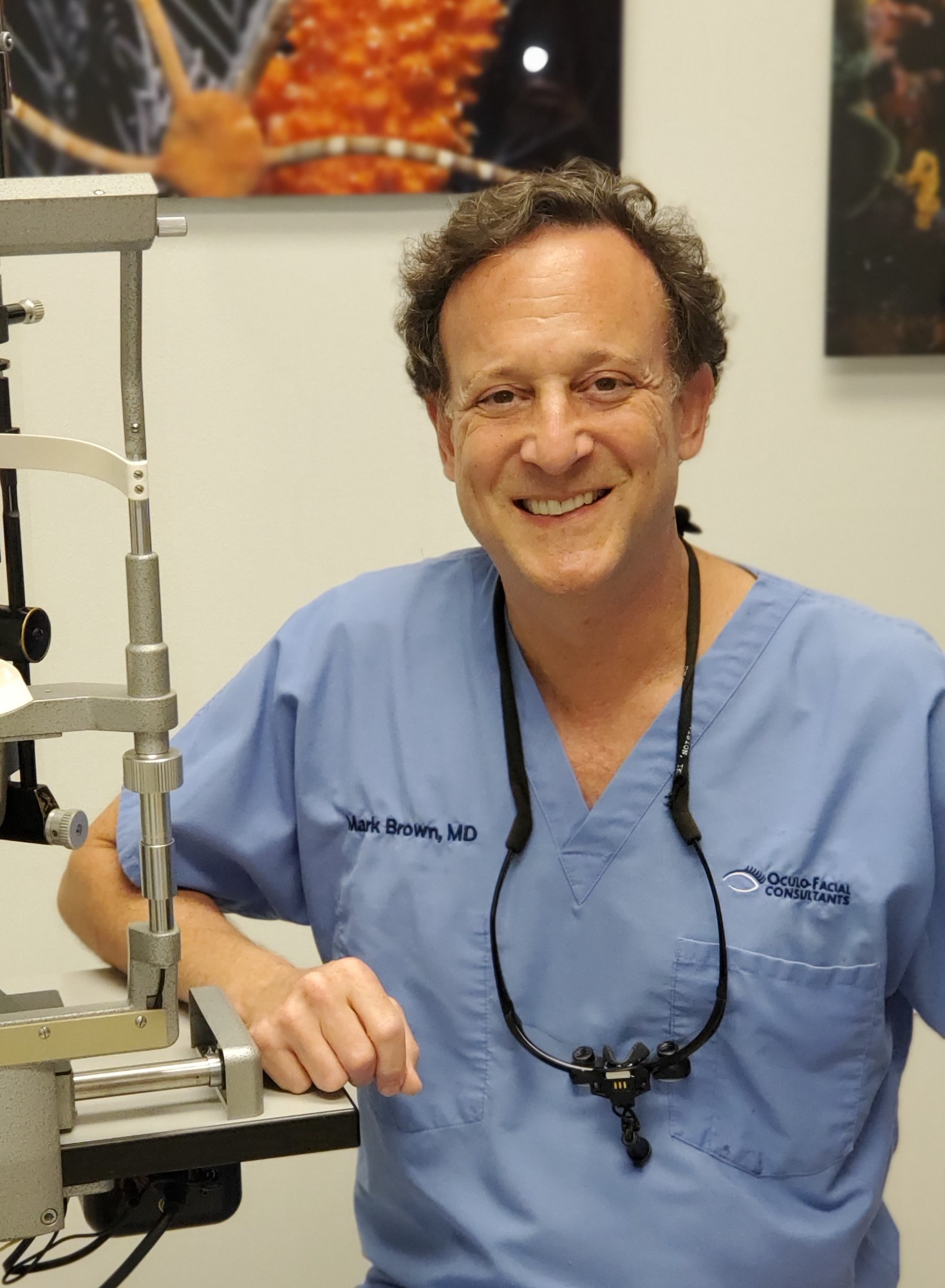
Mark S. Brown, MD
Oculoplastic surgeon at Oculo-Facial Consultants and founder of AcuityMaster. In clinical practice since 1998.
See AcuityMaster in your own exam lane
15-day fully functional trial — every chart and optotype, no credit card.